AI Strategy / 5 min read
Organizational compression: AI as a new operating leverage for the enterprise
Organizational compression shows why AI becomes operating leverage for more agile enterprises that decide and execute with less friction.
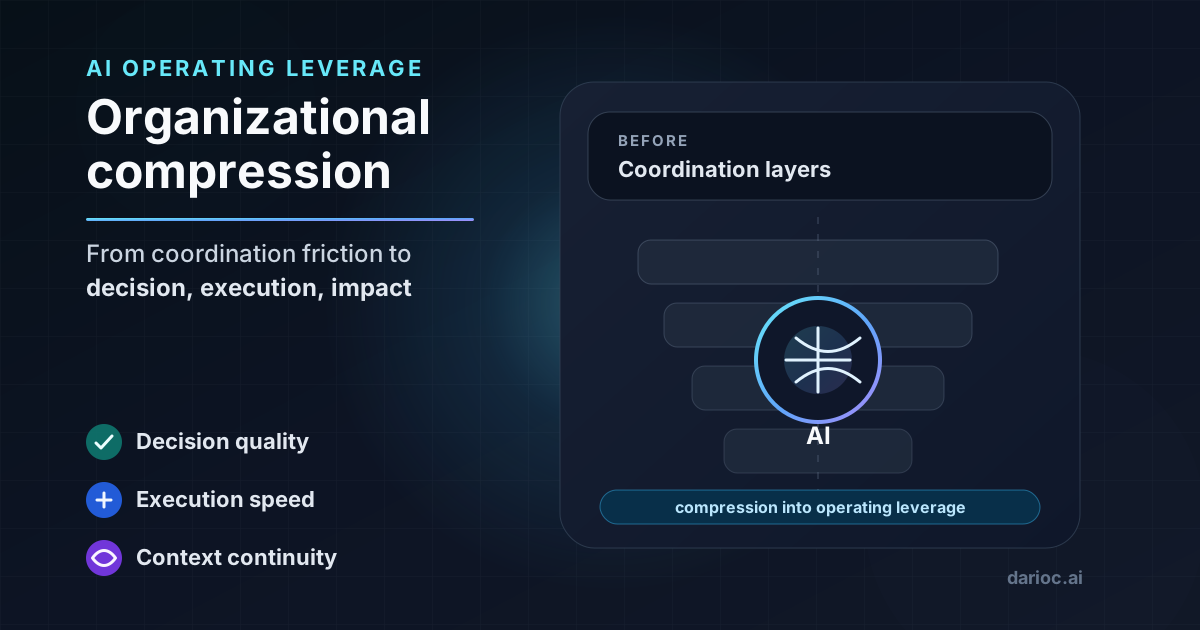
The most useful way to read the impact of AI in business is to start with a simple question: how much more can a team make happen with the same time, attention and energy?
That is a question of leverage.
Leverage is the multiplier between effort and effect. Every organization looks for leverage: it wants to turn decisions, expertise and processes into broader, faster and more reliable outcomes. AI becomes valuable here because it increases the operating capacity of people without requiring every improvement to become a larger structure, a longer process or another coordination layer.
The point is not only to do the same activities faster. The point is to create a new relationship between intention, decision and execution. For executives, this means reading AI as an operating-model lever: not a separate technology layer, but a way to increase the organization's ability to decide, produce and adapt.
The new leverage AI brings into the enterprise
In a company, leverage appears when a person, a team or a function can amplify its impact. AI adds a powerful form of leverage because it makes cognitive capabilities available on demand: analyzing, synthesizing, comparing, writing, designing, simulating, prototyping and preserving context.
These capabilities matter because they operate on three practical levels.
The first is decision quality. A team can explore more options, read more signals, compare more scenarios and arrive at a choice with greater clarity. For leadership teams, this reduces the cost of uncertainty and improves the quality of decision conversations.
The second is execution speed. Many intermediate activities — preparing a first draft, turning notes into a document, generating alternatives, summarizing information, creating an initial proposal — become more fluid. The advantage is not only time saved: it is the ability to increase the number of useful iterations before a decision.
The third is context continuity. AI can help hold together goals, constraints, prior decisions, open activities and dependencies across projects. This is often where organizations lose energy: not in the individual task, but in keeping everything around the task aligned.
The key point is that AI makes part of cognitive work scalable: it does not replace human judgment, but expands a team's ability to analyze, produce and coordinate work with less friction.
Why this changes the shape of the firm
Every company has a shape: what is managed centrally, what is delegated to teams, what is outsourced, what requires approval and what can be decided close to the problem.
That shape depends heavily on coordination costs. When coordination is expensive, companies create more layers, more processes and more specialization. This is a rational choice: it makes work reliable, repeatable and controllable.
AI changes this dynamic because it lowers a meaningful part of the organizational effort. It helps turn scattered information into usable synthesis, vague goals into operating plans, open discussions into traceable decisions, and early ideas into prototypes or documents ready for validation.
The result is that some capabilities can move closer to the point of need. A sales team can prepare a richer customer analysis. A product team can explore variants before involving every function. A consultant can structure hypotheses, risks and options before opening a broader discussion.
This increases the value of specialist expertise. Specialists can intervene on better-prepared problems, with richer context and a clearer base of work.
The firm changes shape because the organizational question changes: which decisions must remain centralized, and which ones can move closer to action?
Organizational compression
The practical consequence is organizational compression: activities that once required many steps can be handled by smaller decision units, with more autonomy and more execution capacity.
This is not about imagining companies without structure. It is about designing lighter structures, where AI supports coordination and people can focus on judgment, priorities, relationships and accountability.
In practice, organizational compression appears through three connected operating effects.
1. Capability expansion
AI allows teams to perform more functions with greater autonomy. A product manager can reach a clearer prototype. A sales team can prepare stronger account research. An operations function can document processes and identify bottlenecks with more continuity.
The value is not "becoming expert at everything". The value is arriving better prepared for expert contribution and increasing the quality of iterations.
2. Parallel throughput
AI makes it possible to explore more paths in parallel: solution options, message variants, technical hypotheses, customer scenarios and implementation plans.
The person still holds direction, but can evaluate more alternatives before deciding. This increases the pace of learning and lowers the cost of exploring different possibilities.
3. Lighter coordination
A large part of business work is keeping context, decisions, dependencies and progress aligned. AI can become an operating support for tracking open threads, turning goals into tasks, preparing handoffs and making decisions clearer.
When coordination becomes lighter, teams can devote more energy to the choices that matter.
What leaders should do next
For leaders, the question becomes very concrete: where can AI increase the organization's ability to decide, execute and coordinate better?
The answer does not start from a list of tools. It starts from a managerial reading of work: where value is created, where friction accumulates, where context is lost, and where a decision could move closer to action.
From there, five operating priorities follow:
- Map work by cognitive function, not only by job title, distinguishing analysis, synthesis, production, control, decision and coordination.
- Identify where coordination absorbs more energy than execution, because that is where AI can release managerial and operating capacity.
- Look for workflows where synthesis, comparison, drafting, prototyping or state management can become more fluid and measurable.
- Redesign operating models around more autonomous, better-informed teams supported by AI context.
- Use governance to scale leverage safely, with clear boundaries, responsibilities and quality criteria.
The enterprises that benefit most from AI will be the ones that use it to increase the quality of work and redesign how work moves through the organization.
Productivity is only the first layer. The deeper transformation is this: AI increases how much action a decision unit can coordinate.
This is where the more agile enterprise emerges: more capable of turning intention into execution, context into decisions and knowledge into impact.
From this perspective, AI is not simply an accelerator. It is a new operating leverage for building organizations that are clearer, more adaptive and more capable of acting.
About the author
Dario Cargnino
Senior Pre-Sales Manager, Solution Architect and Agentic Engineer
I work across AI strategy, solution architecture and enterprise digital systems, with a particular focus on operational trust, delivery realism and long-term platform resilience.
Article signals
At a glance
- Published
- July 7, 2026
- Reading time
- 5 min read
- Category
- AI Strategy
Topics